Targon Climb tips and strategy
Practical Targon Climb tips: read prompt conditions, judge rarity tiers, plan the 30-second timer and avoid the mistakes that keep answers at Krug height.
Checked 28 November 2026 · Browser controls and original game documentation
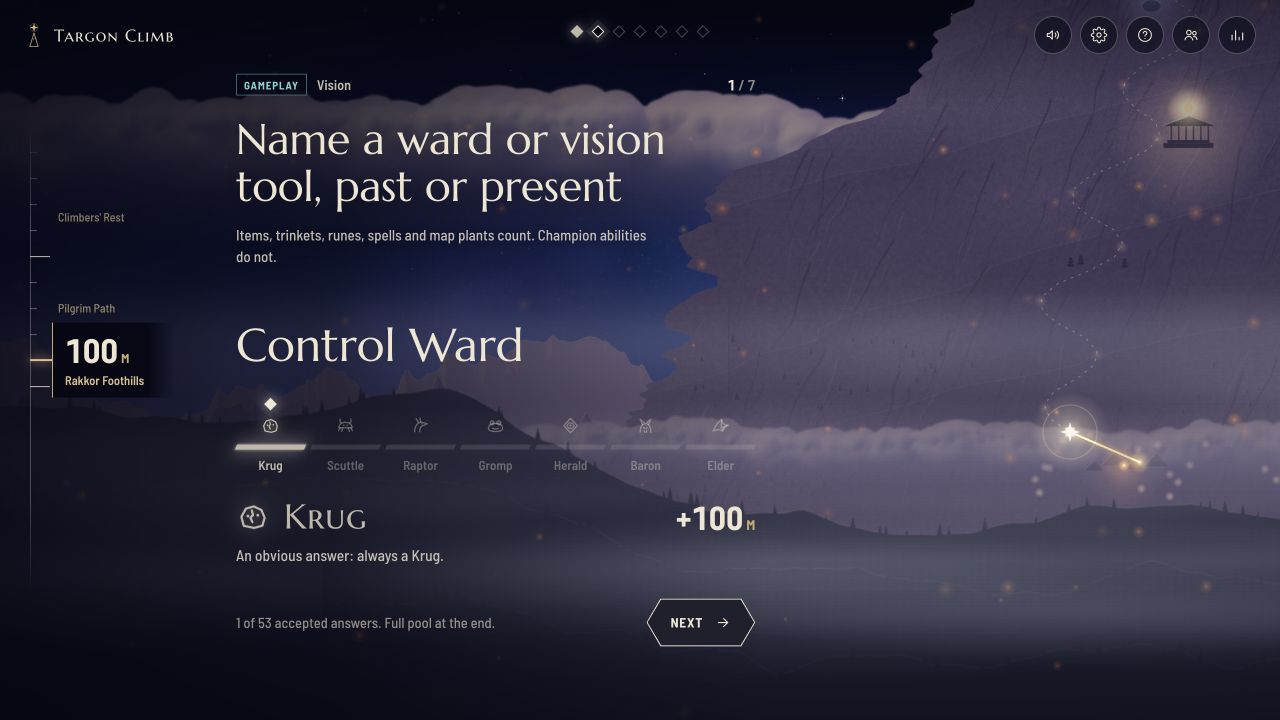
Targon Climb rewards a valid answer that other players are unlikely to give. That single rule makes most "rare answer" habits wrong: a name that sounds obscure can still be a popular response, and a famous name is not automatically a low tier. This page is about the decisions you make inside the 30 seconds, not about today's answers, which this site does not publish.
Read the condition line before you think of a name
The category at the top of a prompt is a starting point. The line under it narrows the pool: a question about items you can buy now accepts different names from one about anything that has ever existed. The game's own FAQ says some prompts print their rule directly under the question for this reason.
So spend the first seconds on the boundary, not on recall. Ask what the prompt excludes, then look for a name that fits every printed condition. A champion strongly associated with the category still scores nothing if it fails a qualifier.
Why an obscure name can still land on Krug
Rarity is built from player behaviour. At midnight the game counts the previous day's answers, and the more people gave an answer, the lower it sits in that question's tier spread. Very common answers are worth a Raptor at most — roughly a tenth of players on most questions, a larger share where a question has only a few valid answers.
The tiers then stay fixed for the whole day, so every player is scored on the same scale. Two consequences follow:
- Obvious answers stay Krug however few people say them. Players skip the obvious name to chase a rare one, so on raw numbers something like Flash could look rare. The game blocks that: an obvious answer stays Krug and your result marks it.
- An Elder Dragon is the rarest answer players have actually given, not the strangest name you can think of. If nobody has given your deep cut, it cannot be the rarest answer on that question yet.
| Marker | Height | What it means |
|---|---|---|
| Krug | 100 m | The floor: common or obvious answers |
| Elder Dragon | 1,000 m | The rarest answers players actually gave |
| Summit | 3,200 m | A named milestone; the climb continues above it |
Do not memorise an answer pool
Because tiers are rebuilt from the previous day's answers, a list copied from another player is out of date the moment the questions change. A name that scored 1,000 m on an old question tells you nothing about a new one. What carries over is the habit: read the qualifier, generate two or three candidates, then pick the least obvious one that still fits.
Past climbs are the place to practise that habit. They are earlier dated sets, they do not count toward streaks or stats, and they let you see how a question family behaves without spending the day's scored attempt.
Build candidates by question type
Use these as thinking prompts when a question concerns the named subject. They are suggestions for generating valid candidates, not a claim that the game uses five fixed categories or that a particular choice will earn a rare tier.
Champion prompts
- Identify the exact filter first: a role, release period, faction or another printed condition. A champion needs to meet that filter, not simply remind you of it.
- Recall candidates beyond your most-played champion: think through a different role or part of the roster you know well, then check the same condition again.
- Keep one confident candidate in reserve while considering alternatives. A less familiar name is only useful when you can explain why it belongs.
Item prompts
- Distinguish items available now from historical items. A remembered name needs to fit the time boundary in the question.
- Check whether the prompt asks for a component, a finished item or something in a recipe; do not treat those as interchangeable.
- Start from a build you recognise and consider its other eligible items. Check each against the wording instead of assuming an entire build qualifies.
Ability prompts
- Check whether the answer should be an ability name or the champion who owns it. Those are different response types.
- Read any restriction on passive effects, spell slots or other ability properties before recalling a candidate.
- Use a name you can identify confidently. Shorthand for a champion does not establish that a shortened ability name will be accepted.
Lore prompts
- Separate playable champions from other named characters if the question makes that distinction.
- Distinguish a stated event or relationship from something you merely associate with a character.
- Choose among details you remember clearly; a strange-sounding name does not make an uncertain lore connection valid.
Region prompts
- Check whether the condition concerns birthplace, present allegiance or another connection to the region.
- Recall candidates through different groups or stories you know, then verify the requested relationship for each.
- Resist substituting a visual theme for a regional fact. Similar clothing, magic or scenery can suggest a candidate to check, rather than establish the answer.
Spend the 30 seconds in three parts
- Understand. Read the category, the prompt and any printed condition. This is where most lost height comes from, not from typing speed.
- Choose. Hold two or three candidates and compare them against the qualifiers. The first name you remember is usually the most common one.
- Submit. Typing does not lock the answer in: press Enter or use the game's submit control. On a phone, check that the keyboard is not covering that control before the timer runs low.
If a spelling suggestion appears, read it before accepting. A correction that changes your intended name costs you the answer you planned.
Use the feedback button when a valid answer is missing
Answer pools are built from the League of Legends wiki, Riot's game data and op.gg pick rates. Where a valid answer is missing, the game offers "This should count": the report is checked by hand, and the first accepted report on each question gives you five seconds back. That is both a fix and a small time bonus, so it is worth using when you are confident.
Practise without spoiling the round
After a round you can open the answer pools. That is useful for understanding a question family, and it is exactly what ruins a friend's first attempt. Share your height and the category you found hardest first; ask before reading names aloud. The game's Spoiler mode keeps answer lists hidden while you stream or share a screen.
Where to go next
- How to play Targon Climb for the interface, controls and submission steps.
- Scoring and rarity tiers for how each tier turns into height.
- Modes and Past climbs for practice, Free Climb and the friends format.
- Games like Targon Climb if you want another daily League quiz.
No strategy guarantees a tier: the game scores what the crowd answered. These habits only stop you from wasting a valid answer on a crowded tier.